Sunday, 13 September 2009

Product Placement: UPDATE

After my previous blog entry about 'Product Placement in the UK', there have been some dramatic changes! Today I heard on the news that the Government has lifted the ban on product placement, thus changing the future of British TV forever. I wonder why the government made this major U-turn in their views of product placement, as my last blog entry on this subject discussed, they previously seemed really against the idea. Perhaps it's the £100 million a year that this move will be worth to commercial channels- an economic boost they could all do with in the current situation.

There are some exceptions however. The BBC will still be prevented from using product placement, but do still benefit from the change as it will reduce the pressure on the BBC to share its £3.6 billion income from the license fee. Another exception will also be children's TV.

I think if done well, this will certainly have a positive impact for both advertisers and broadcasters, not only because of the large amounts of money it will bring in, but also because of the self-scheduling method of watching TV that is becoming more and more literal. Many digital packages such as Sky+ allow viewers to fast-forward commercial ad breaks, making them less successful for advertisers, and therefore making less money for broadcasters too. Product placement could therefore open doors for advertisers and broadcasters where others are being closed- there couldn't be a better time for it.

McCurry Branding Row

American fast food company McDonald's have just lost an 8 year legal battle with Malaysian fast food company McCurry, as McDonald's argued that they were infringing their trademark rights by using the 'Mc' prefix in their brand name. The owner of McCurry explained that he used the brand name as an abbreviation of 'Malaysian Chicken Curry', and it was ruled by a federal court that there was no evidence of him trying to promote the company as part of the worldwide brand of McDonald's.
When I initially saw the logo for McCurry it really did remind me of the McDonald's brand. But as the 'Mc' prefix is common in surnames anyway, and the owner seems to have a valid reason for using it, I don't see how McDonald's can really copyright the use of it. Perhaps if the Company used an alternative colour scheme it wouldn't resemble McDonald's as much. I think the ruling was fair though.

The Shock Tactic in Advertising... UPDATE

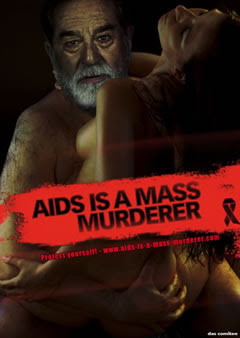
Just read Elizabeths Pisani's view on this advertisement in the Guardian, who objects to the ad but not due to the shock tactic. She points out the inaccuracies of the ad- 500 people died if Aids in Germany in 2007, which is no where near as many people as Hitler killed. She also points out that "almost all sexual transmission of HIV in white communities in Western Europe is between [gay] men", so targeting straight women will hardly reduce the risk of HIV in gay men. The advertising agency 'Das Comitee' who did the campaign did it unpaid- perhaps this accounts for the lack of research into who they should be targeting? unless the brief stated it of course... Pisani also argues that HIV is no longer even a mass murderer in rich, developed countries, and more an "inconvenient disease that will have you taking pills for the rest of your life [and] cost taxpayers lots of money".
If the agency simply did this to promote themselves, and saw it as an opportunity to create a shock-campaign in order to receive world-wide media coverage, it definitely worked.

Wednesday, 9 September 2009

The Shock Tactic in Advertising...

Too Far or Highly Effective?


A recent advertising campaign in Germany caused controversy, when an Aids awareness campaign showed a woman having sex with a series of mass murderers, including Adolf Hitler, Saddam Hussein and Joseph Stalin. The Hamburg advertising agency, Das Comitee, used the shock tactic to highlight the dangers of unprotected sex and the horrific 'mass murder' effects of aids, with the slogan "AIDS ist ein Massenmorder" ("AIDS is a mass murderer"). The creative director of the agency said their aim was to "show the ugliness of the illness, not of aids victims", but various Aids organisations across Europe have condemned it, saying it represents aids sufferers as mass murderers.
I can definitely see how aids sufferers would be offended by this, as it appears to represent the sufferers as the murderers rather than the illness itself. However, I think this shock tactic will definitely work as an awareness campaign, and make people realise of how easy it is to contract aids. Another criticism though... if you watch the TV/Cinema advertisement http://aids-ist-ein-massenmoerder.de/typo3/index.php?id=aids_kampagne&L=1 there is no advice on how to prevent catching aids.

Ambient Advertising

UKTV channel Dave recent advertising campaign...

The marketing people behind the UKTV channel Dave recently came up with an ambient marketing campaign, just in time for this years channel of the year awards. They placed a couple of old brown suitcases, presented with stickers on them reading "The case for Dave", onto baggage carousels at Edinburgh airport. They were heaved off, and on again, over and over. Although being the perfect time of the year for the use of this location for a campaign, I wonder why they only did it in one airport, and not in others and train stations. However, I also don't admire the campaign much for lack of creativity, and realise maybe the campaign wasn't very successful and so resulting in no further coverage.

I found this much more creative Dave campaign from last summer to promote the "summer of funshine" schedules, which will see great British comedy series, such as Blackadder, Open All Hours and The Vicar Of Dibley, broadcast every evening. The campaign says much more about the channel's personality, involved the public directly and was more widespread. The initial aim was to sponsor students as human billboards, and to stencil faces of British comedy onto their back. However, as the campaign became more widespread, anyone and everyone who wanted to get involved could. This campaign appears much more thought through- it's fun and links to the promotion directly, while in keeping with the summer spirit and British comedy.

Wednesday, 2 September 2009

American Apparel Ad Ban in the UK

I have just read in an online news article, that the UK advertising standards authority have made the decision to ban a campaign by American Apparel retails. This was due to a series of photos of a model who appeared to be under the age of 16, who was stripping off for what looked like an amateur porn shoot.
The ban came after the ASA received a complaint on the campaign, that it was offensive, unsuitable for younger audiences, and inappropriate, as the model appeared young and vulnerable. American Apparel defended the ad, by saying the model was supposed to be perceived as a 23-year old woman, relaxing in her hoody around her apartment, in order to reflect the soft-to-touch material. The ASA agreed that they had not breached any of the advertising codes on nudity, but banned the ad on the basis of the model appearing to be under 16, and progressively showing more and more flesh through the series of photos. They concluded that the ad could create serious offense for some readers.
Although the ad doesn't show much nudity, I can definitely see why it could cause offense, as the girl does appear to be very young and naive, and rather vulnerable to the situation. American Apparel have created a lot of controversy over their sexual campaigns in the past, so this comes as no surprise to me.

Tuesday, 1 September 2009

Dr. Gunther von Hagens

My previous post on Damien Hirst brought up a discussion between my sister and I about artists who dissect animals and plants for their artwork. She showed me a catalogue from an exhibition she went to on Dr. Gunther von Hagens' work, which I know she has researched and studies quite a bit. I've never really taken much notice of his work before, as I didn't really want to see dissected and stripped human bodies, but some of the ones shes showed me were artistically presented in various ways, using a range of techniques. I also feel strangely more comfortable about his work than I do with Damien Hirst's, as I know all the people he uses have signed up and volunteered for their bodies to be used once they have died. I also spoke to my housemate who is a medic, about Dr. Gunther von Hagens' work, and he was very in interested in seeing some. My sister said that the exhibition attracted a lot of medic students interested in the dissections, as well as art lovers- I think it's great how he's managed to add this unique take on art, and attract many different audiences.

One of his techniques is also interesting, as he injects their blood streams with plastic based material, allowing it to take the form of the body.