Tuesday, 1 September 2009

Dr. Gunther von Hagens

My previous post on Damien Hirst brought up a discussion between my sister and I about artists who dissect animals and plants for their artwork. She showed me a catalogue from an exhibition she went to on Dr. Gunther von Hagens' work, which I know she has researched and studies quite a bit. I've never really taken much notice of his work before, as I didn't really want to see dissected and stripped human bodies, but some of the ones shes showed me were artistically presented in various ways, using a range of techniques. I also feel strangely more comfortable about his work than I do with Damien Hirst's, as I know all the people he uses have signed up and volunteered for their bodies to be used once they have died. I also spoke to my housemate who is a medic, about Dr. Gunther von Hagens' work, and he was very in interested in seeing some. My sister said that the exhibition attracted a lot of medic students interested in the dissections, as well as art lovers- I think it's great how he's managed to add this unique take on art, and attract many different audiences.
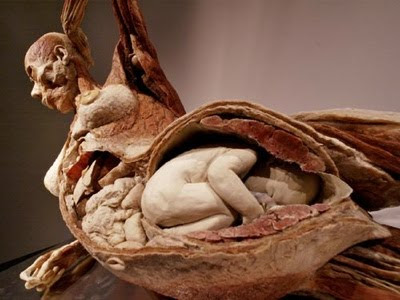
One of his techniques is also interesting, as he injects their blood streams with plastic based material, allowing it to take the form of the body.

Friday, 28 August 2009

Death Valley Ghost Town

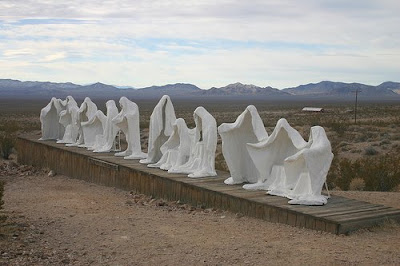
A couple of years ago while travelling around West Coast America, I accidentally came across this ghost town I have since learned is called Rhyolite. unlike other ghost towns I visited, it's none commercialised, and can be seen totally how it was when the last person left, exposing it to natural changes over time. It was so eery especially being situated within the hottest place on earth, and within an area titled 'Death Valley' due to these deathly humid and hot conditions. Very little animal life can be seen- very rarely maybe a snake, but no sound except the warm breeze can be heard. Adding some strange, contrasting forms to the naturally disguised homes and cars that have been deserted, is the Goldwell Open Air Museum including the Ghost sculptures shown below, which play upon the deserted area and the eery-ness of the town.


I have since learned that the town is becoming much more commercialised and promoted, which I'm disappointed about- Stumbling across the town allowed me to get a true feel for the atmosphere and a sense of discovery and exploration into a world where people once lived.

I have also just read that there are a range of films created there, including 'The Island' which was recently on TV. I wish I knew that before I watched it as I would have appreciated the setting a lot more. I'm not surprised to learn that other films such as 'The Arrogant', 'Ultraviolet' and 'Bone Dry' were filmed there, as its such an atmospheric place, and must save a lot of money rather than designing and creating an environment set from scratch.

Gustav Adolph Mossa

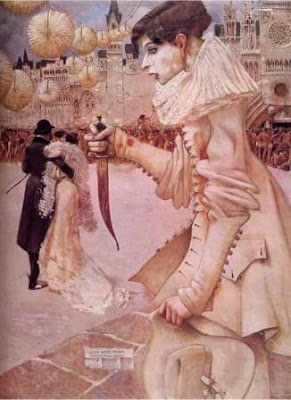
Last summer when I visited Nice, while travelling to Italy, I discovered an artist who I'd never heard of before. Gustav Adolph Mossa's artwork was on display in the Musee des Beaux- Arts in Nice when I went, and I was amazed by the fine detail in his work. As a designer who used to paint a lot, I find his work very inspirational through his technique and style, and the themes of his artwork often very intriguing. Bellow is one of my favourite pieces of his- 'Pierrot s'en va'. Every time I look at it I want to know the story behind it- I'm not sure if I've made this up through my imagination, or whether it's the true depiction, but I think the main clown-like character has just stabbed himself, for his loss over the women in the background who he loves. This is something I certainly want to research.


Nature's Design


Nature is always an inspiration throughout various aspects of design. I love this photograph of icicles over a car, and the tree in the background. It looks like the falling of ice frozen in time, with the icicles pointing in the direction of the wind. I can't remember where this was taken which is a bit annoying, but it's still a great photo to look at. I would definitely hate to have to walk to Uni over that though!

The Basilica di Santa Maria del Fiore


While in Italy over the summer, I visited this beautiful Cathedral. Although I have visited hundreds of Cathedrals during family holidays in the past, and despite previous to the holiday deciding not to write any entries on Cathedrals or churches that I visit, I couldn't resist this one. I have never experienced an architectural design so exquisite and breathtaking. When we sat by it to eat our lunch I found it's beauty and elaborate design kind of surreal. Although quite garish and its criticism for being overly fancy, I really admire the design and time that must have gone into every statue, and every pattern design. The inside is somewhat odd in that it's so unlike the facade- bare, gothic and quite empty, which was designed to represent the austerity of religious life.

Advertorials

The Line Between Editorial and Advertising.
'Supplementary Income' The Media Guardian, 31/08/09
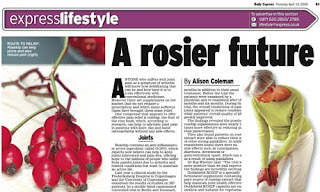
Advertorials are becoming more common and increasingly subtle, resulting in many initially being confused with journalism articles rather than a promotion. The Daily Express was heavily criticised earlier this month by the Advertising Standards Authority (ASA) and Watchdog, for disguising advertorials as news stories (the Goldshield Rozip advertorial pictured below). It is within the ASA code that all advertising features must be clearly labelled as an advertisement.

Despite this criticism of the Express as a result of advertorials, as marketing budgets become more strained, advertisers who are looking for better ways to make brands stand out are increasingly turning to advertorials. Justine Southall, publishing director of Cosmopolitan, says that last year was their best ever for advertorial features, and that this year they are on a similar track. Southall recognises the importance of the relationship between the reader and advertiser, as it can also effect attitudes towards the magazine. All advetorials must be clearly labelled, "[including] making sure the point size of the 'Cosmopolitan Promotion' is clearly legible." She also recognises that other publishers may be purposfully disguising promotions with unclear advertisement labelling, due to the current economic conditions, and says that "this is really dangerous for the long-term health of a brand."

Advertisers are not attracted to the fact that readers may be put off reading an advertorial if it is labelled as an advert, and are so looking for alternative methods of attatching brands to editorial. But feature editors themselves are very warey of getting carried away, and ensure not to push too many products into editorial spaces, in order to avoid annoying readers.

In conclusion I think it is both advertiser's and media owner's responsibility to manage the line between advertisements and editorials. Advertisers must satisfy the ASA's code, and journalists must control the level and amount of advertorials readers are presented with. It will also be interesting in the future to see what new ways advertisers will be linking brands to editorials.

Product Placement in the UK

The ban of product placement is viewed as a problem by many advertisers and broadcasters, especially since Andy Burnham, then the culture secretary, earlier this year said that the ban would continue for UK television. He said it would blur the boundaries between advertising and content, and his "priority has always been to make sure we maintain levels of trust between audiences and broadcasters, and protect the standards of broadcasting for which Britain is known worldwide." Cody Hogarth, managing director of New State (Endamol's branded content division), backs up Burnham's decision by saying: "I don't think we'd ever find a commissioner who would take a programme that had product placement all over it."

The Conservative party however, has a different view, as they say they would relax the product placement rules- Ed Vaizey, the shadow minister for culture says "We don't think that product placement is a panacea for all the ills of commercial broadcasting. But we do believe that we should relax the rules." It has been estimated that product placement in the UK could be worth between £40m and £70m a year. Vaizey says "we also trust the broadcasters to understand their audience."

All parties also recognise that UK viewers are already viewing heavy product placement in programmes imported from the US. Mark Eaves (managing director for Drum PHD media agency) says "we either level the playing field or we take steps against imported programmes and series."

I know there has been concern about whether UK audiences would react well to product placement in programmes, but as Eaves points out, we are already used to it from the imports. Surely the decision should be whether we allow them on all programming, or not at all. However, Rabin Mukerjea, partner at the Grand Central Entertainment content agency, disagrees with this. "If there was a way of us fast forwarding, we could do what the US does- right now we'd be starting from year dot, so how long it would take to learn that lesson I don't know." Mukerjea argues that it's not a case of either having it everywhere or not at all. It would be something that programmers would have to ease into, with a risk of how audiences would react- US audiences are used to it everywhere as it blends into backgrounds. But product placement may stand out and distract audiences in the UK.